Three weeks in Sri Lanka (Part 1)
The hiking part
Reading time: 33 minutes. Published on .We spent our 2025 holidays in Sri Lanka, going for a hike, culture, and beaches. In this first part, follow along for our adventures on the Pekoe Trail, starting from Kandy.
- Getting there (17.10. and 18.10.)
- Trip overview
- Kandy is good for your teeth
- First hiking day: Pekoe Trail, beginner mode (19.10.)
- Second hiking day: It’s growing on us (20.10.)
- Third hiking day: In which I get made fun of (21.10.)
- Fourth hiking day: Full of surprises (22.10.)
It appears that, after our holidays in India (2023) and Indonesia (2024), I had idly mentioned that we might consider Sri Lanka as our next destination. At least, that’s what my wife Vivi maintains.1 Anyhoo, Sri Lanka (2025) it was. Bright and early on a Friday, we started our journey.
Read the second part here.
Getting there (17.10. and 18.10.)
There is exactly one direct flight between Germany and Sri Lanka, departing from Frankfurt a few times a week. We’re suckers for not having to change, so that’s what we booked.
Now, quick question to my German readers: How much buffer would you schedule between a train ride from Munich to Frankfurt and departure at Frankfurt Airport? The correct answer is yes, which translates to approximately three and a half hours.2
Annoyingly, the train was super on time, so we found ourselves in a situation where we had to kill over three hours at Frankfurt’s infamous Terminal 2. We spent about a third of that finding someone who was willing to accept our luggage. But that wasn’t even the most confusing part of Terminal 2: We were allowed to sit in front of the gate, only to be shooed out again, only to be let in again. I’m sure there is some method to this, but it cannot be divined by passengers not blessed with at least gold status.
The flight itself was delayed, but uneventful. We arrived at 05:30 in the morning (local time) and sailed smoothly through the airport, picking up cash and an eSIM on the way.
The next leg would be to board a train to Kandy, our destination for the night. Now, train tickets in Sri Lanka, especially on the touristy route from Colombo via Kandy to Ella, should be booked in advance. When preparing for the trip, I wasn’t sure which train to book. The preferred 10:35 service was already booked out, so I booked both 08:30 and 12:50, which fortunately wasn’t overly expensive.
A note about trains in Sri Lanka
There are a few ground rules that you should follow:
- Try to book well ahead of time. Trains sell out fast. You can always get a ticket on the spot at the train station, but you might end up standing in an “unreserved” coach.
- Always book directly at the official website. Do not book through third-party websites. I’m not aware of any mobile application, and the website isn’t terribly mobile-friendly. Try to use a laptop or tablet. Tickets are issued as QR codes which you may want to print out. The ticket inspectors will check your ticket very thoroughly, including your passport information.
- Things aren’t as strict for commuter trains: you can’t book them online, they only have unreserved coaches, and you may only want them to use for short distances. As far as I can tell, they’re not even listed on the booking website.
- Expect delays. Use the unofficial RDMNS app for live schedule, but don’t rely upon it too much. My understanding is that volunteers observe trains passing by and feeding that information into the app. It’s still a great app.
Find more details at Seat61, including about train schedules, configuration, and classes.
Because we were aleady out of the airport by 06:30, we easily managed to get to the Colombo Fort train station in advance of the 08:30 service (the taxi ride takes less than an hour).3 We had ample time to walk around, take some photos of the station, and get some samosas for breakfast.
When the train arrived, I wasn’t sure how to find the correct train car. Our reservation just said TCR-29 and TCR-30 as seat numbers, but no indication of a car number. Unfortunately, I handed the printed reservation to a random person, who ran with us all the way to the end of the platform, showed us the correct seats, and (of course) asked to be paid.4
So, in case anybody is wondering: TCR stands for third-class reserved and is in fact the car number (there is only one third-class reserved car). There is also FCR and SCR (first and second), as well as AFC (air-conditioned first).
The train wasn’t too crowded and took us along a very scenic route.
I wouldn’t call the third class very comfortable, but it was perfectly fine for a three-hour ride.
Our fellow passengers at some point started clapping and singing and handing out kandy candy to us.


Around 11:30, we arrived at Kandy station. (Needless to say, Erlend had already been there.) The homestay was just a short ride away, and we made ourselves comfortable at our first accommodation.
| Start | Colombo Fort |
|---|---|
| End | Kandy |
| Train number | 1015 |
| Departure (scheduled) | 8:30 |
| Arrival (scheduled) | 11:08 |
| Seat class | Third class reserved |
Report continues after a short trip overview.
Trip overview
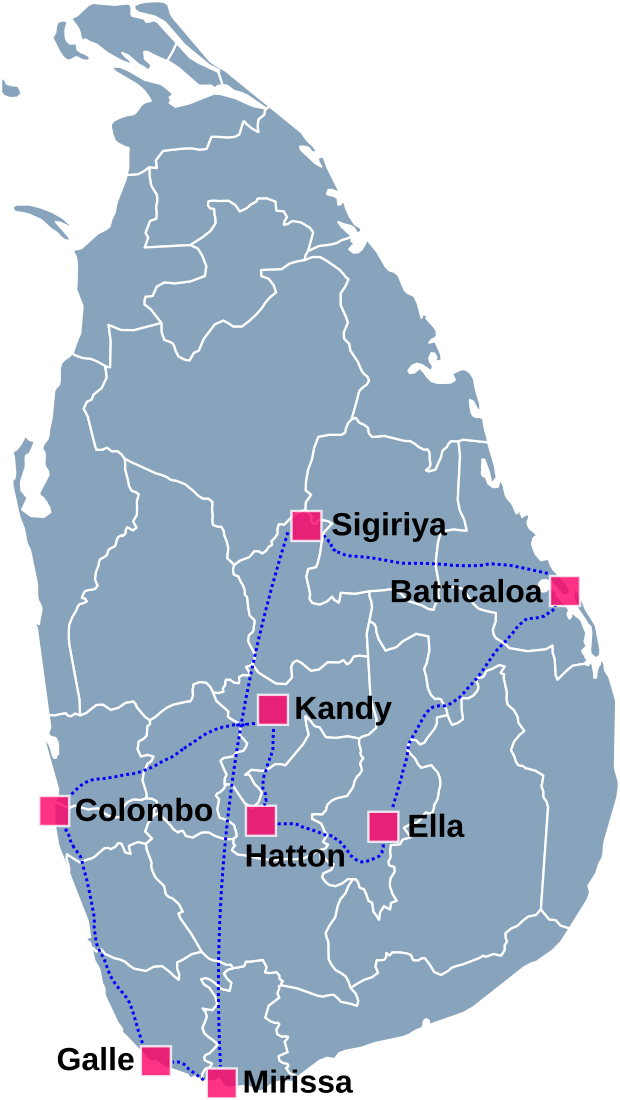
The map shows our trip itinerary:
- Colombo—Kandy by train.
- Hike the Pekoe Trail until Hatton; stay at a different place each night.
- Hatton—Ella by train, and a few days to explore the town.
- Ella—Batticaloa by taxi, since we failed to figure out any bus connections (more about that in a later part).
- Batticaloa—Sigiriya by train for culture & a safari.
- Sigiriya—Mirissa by plane, easily the most exciting transit of the entire trip.
- A few days in Mirissa for whale watching & beaching.
- Mirissa—Galle by train and one night at the historic city.
- Galle—Colombo by train, wrapping up the trip.
On our previous trips, we had booked most of our activities and accommodations in advance. For Sri Lanka, we decided to wing it: When we arrived in Colombo, we only had train tickets to Kandy and stays along the Pekoe Trail to show for our preparations. (Finally, I could leverage my training!)
Everything else we pretty much decided on the ground.5 And even though we had already booked the flight from Sigiriya pretty much last minute, we had to call them to make a change to our itinerary even laster minute. Can you believe it? Anyway, all went well, so: no complaints.
Kandy is good for your teeth
Back to Kandy.
Our host greeted us with a big floofer (of the shepherd kind). Instant sympathy! He (the host, not the dog) then informed us that there would be a festival happening the next day with lots of drumming and singing and offered us a quieter room. We happily accepted and found ourselves in a spacious apartment. As we would learn during the hike, free choice of room would become somewhat of a theme of this trip. (And we would also learn the reason.)
With the afternoon free, we walked into the town and checked out the sights. I, for one, was totally unprepared, having only started reading the Lonely Planet during the train ride, but Vivi steered us towards the Sri Dalada Maligawa, or Tooth Temple.
While we could have reasonably spent the entire afternoon there, it started raining and the jetlag kicked in. Therefore, we went to eat dosa, stocked up on snacks for the upcoming hike, and returned to the homestay.
We used the remainder of the day—before falling asleep—to repack. We sorted the one-week essentials into the backpack, and the rest into the suitcase. The suitcase would then be picked up for storage in the morning.

First hiking day: Pekoe Trail, beginner mode (19.10.)
Map
Download track. Always check current track conditions, since they can change rapidly. I do not guarantee correctness.The Pekoe Trail is, according to its website, a “300 kilometer, carefully curated long distance walking trail that winds through the Central Highlands of Sri Lanka.” It comprises a total of 22 stages, each around 15 kilometers, which makes them perfect day tours.
Note that you need to buy a day pass for a particular stage to hike, or a one-year membership. We got the latter: I recommend having the PDF or a paper copy with you, although nobody checked on the trail, as far as we were aware.
We started—naturally—with the first stage, taking us from the Hantana Estate near Kandy to Galaha. We had breakfast at a bakery down the road and took a tuktuk for the twenty-minute ride to the starting point.6
Beautifully, that point is the Ceylon Tea Museum, housed in a former tea factory. When we arrived, it wouldn’t open for another fifteen minutes or so. I remember being a little concerned about being able to start in time, so we rushed through the exhibition: one could easily spend two hours there, including a tea sampling. (In the end, the rush wouldn’t have been necessary at all, since it took us less than four hours to arrive …)
Onwards.
The hike took us along dirt roads, paved tea estate roads, and the occasional narrow forest path. We encountered villages, villagers, and a litter of puppies. After only a few kilometers, we crossed the main road connecting Kandy to Galaha. Up in the mountains is a beautiful stupa. We passed by just as some ceremony began; the sound of the gongs could be heard far and wide.
Just a little later, we would find a rather odd place directly on the trail. As the guide describes:
You’ve arrived at the Sugarcane Quarantine center – yep! If you are carrying any sugarcane on you (as you do) how sure can you be that it’s safe and secure? If in doubt speak to these guys, your sugar cane can quarantine here—not a bad place to quarantine if you ask us!
I’m almost a bit sad that we didn’t bring any sugarcane just as a pretext to chat with the sugarcane quarantine officers. The dogs hanging around the building found us interesting and followed for a bit.
Other notable encounters, in increasing order of frequency:
- an Australian couple; as it would turn out, one of the very few fellow hikers on the trail
- large boulders the size of small boulders; those had to be climbed
- leeches; more about those later.
As is usual in October—also known as “beginning of the rainy season”—it started drizzling around noon. Nothing that we weren’t prepared for, though. But on that first hiking day, the weather was kind to us: The drizzle only lasted a few minutes, and gave way to beautiful sunshine.


As we were closing in on our destination, we deviated slightly from the official trail. There is a dearth of accommodation in Galaha, so we picked something a bit outside of town.
The entire walk, I had a slightly uneasy feeling about our lodge: It had 0 ratings on the various booking portals, and it wasn’t to be found on Google Maps. Fortunately, I recognised a sign that coincided with the location according to our booking confirmation. When we walked down the side road, we found … nobody.
I phoned the number on the confirmation. (I know, how millenial of me.)
Hello, is this [redacted]?
—Yes.
We have a reservation and there’s nobody here.
—Well, we are closed.
I knew it! I was right to feel uneasy!7
Not to worry, though. The person on the other end of the line promised to the caretaker to set up the room. And, hey presto, someone arrived quickly, let us into the room, and provided us with tea. The various critters (mice, lizards etc.) hanging out on the porch were largely unperturbed.
We hung up our clothes, peeled off the leeches, and decided to go into town to grab some food. As we were walking out of the estate, towards the main road, our luck ran out for good.
What started as another drizzle quickly turned into torrential rain. My ever more frantic attempts at calling a tuktuk were frustrated. A random driver passing by took pity and us along for the ride.
In Galaha, it was challenging to find an open eatery. When we finally did—with only one umbrella between the both of us—I was soaking wet.
What did we learn? It tends to rain in this region in October. Bring at least one umbrella per person.


We made our way back to the lodge and went to sleep early. This was an excellent stage: The only thing I would’ve done differently is perhaps to get the food earlier, that is, before the rain.
| Stage | 1 |
|---|---|
| Start (actual) | Kandy/Ceylon Tea Museum |
| End (actual) | Just before Galaha |
| Elapsed time | 3:50 |
| Moving time | 3:10 |
| Distance | 12.6 km |
| Ascent | 430 m |
Second hiking day: It’s growing on us (20.10.)
Map
Download track. Always check current track conditions, since they can change rapidly. I do not guarantee correctness.Early start! We left our accommodation at 07:00 and started walking towards the town. After a few meters, we managed to hitch a ride again, dropping us directly in front of a place serving breakfast. We didn’t exactly know what they had on offer, so we just asked for breakfast. That turned out to be three buckets of curry (shared with other patrons), as well as dosai, a kind of pancake, and string hoppers, a kind of rice noodles.
Energised, we started the second stage. It was much longer than the first stage, both horizontally and vertically.
At around 10:00, we arrived at Deltota, a small market town. We integrated a few samosas, stocked up on bananas, and proceeded towards a pine forest. Ominiously, the guide already advised that it is “prone to leeches.” It was. We had to stop multiple times to remove leeches that were planning to or already sucking on us. The problem: Once you stop, more leeches will come to you. And those lil buggers are fast!


Some paths were quite overgrown, which made them difficult to walk. (I recommend always checking your GPS.) Perhaps one of the most comical waypoints was a totally overgrown forest section with only a little “entrance” visible in front (see picture). But the views were nothing short of spectacular.
At some point, we arrived back at a tea estate, featuring James Taylor’s cottage, a Scotsman credited for the first tea plantation in Sri Lanka. Also, it seemed to be a popular spot for young lovers: We saw a bunch of couples arriving on a motorcycle, enjoying the scenery. (However, only very few other hikers on the trail.)
Entering and exiting this estate incurs a small fee, to be paid at the information centre at the end of the stage in Loolecondera.


Like yesterday, our accommodation was not directly at the end of the stage. We arrived in Loolecondera and saw a bunch of tuktuk drivers, yet nobody wanted to pick us up. (We were later informed by our host that that was because of Diwali.)
After half an hour, we reached the next village and our homestay. Thankfully, our host made us food—lunch and dinner—so we didn’t have to venture out again. This allowed us to stay mostly dry that day. As most days, we were the only guests in the homestay (with three rooms to choose from).
| Stage | 2 |
|---|---|
| Start (actual) | Galaha |
| End (actual) | Handawalapitiya, Loolecondera |
| Elapsed time | 6:55 |
| Moving time | 4:40 |
| Distance | 18.6 km |
| Ascent | 930 m |
Third hiking day: In which I get made fun of (21.10.)
Map
Download track. Always check current track conditions, since they can change rapidly. I do not guarantee correctness.Another intense stage ahead of us. We had set our alarm clocks to 05:30, but the Buddhist monks from across the street were way ahead of us. We woke up already at 05:00 from drumming and singing.
Still, we had a great start in the day. Our host made us breakfast and lunch packets. He had also arranged a tuktuk driver to bring us to the start of the third stage, a task that was merrily executed at breakneck speed.
When we started, we were above the fog. (As can be seen in the first picture.) But the third stage took us over the Stellenberg mountain pass, scratching the 1600 m altitude mark. The higher we got, the foggier it became. To add insult to injury, the weather added rain to fog. It appeared that thick rain clouds, coming from the northeast, got stuck at the mountain range, forcing us to put on our rainjackets for the first time.
The guide promised “breathtaking views”, but instead, we were fighting to get through the thick forest on an overgrown path. Visibility was at most 10 metres, and we lost sight of each other a few times. Needless to say, the leeches were having a field day. Me and my hiking trousers started showing signs of wear; to the extent that a local woman passing by pointed at them and laughed. On the plus side, we saw some monkeys, literally in the wild.


After we crossed the highest point, we emerged from the forest and the rain subsided. As we walked through a village, we still couldn’t see much, but hear: Kids were throwing firecrackers every few minutes, which is common during Diwali celebrations.
We arrived at our hotel around noon, covered in dirt. We felt a bit bad about entering the premises in this state. But three friendly staffers came immediately and assisted us as we plucked the leeches from our shoes and skin.
During lunch, we learned that the tea factory associated with the hotel had free tours. We got to visit the factory during normal operations and could even pluck some tea ourselves. What’s fascinating about tea factories in Sri Lanka is that they all look similar from the outside, with characteristic metal sheets and green windows.


While there were other guests at the hotel getting the tour, shopping tea, or having lunch, we were the only ones staying for the night. We spent the afternoon almost entirely in the hotel (there wasn’t much outside anyway). I bought a shirt at the suspiciously-named K&M store and indulged in chocolate cake. Meanwhile, Vivi caught up on some reading and free tea.
We also caught up on some trip planning, reserving our accommodation in Ella and booking the train ride there (on the 25.10., so four days from that day). Sadly, the only available service left was the Ella Odyssey, an expensive tourist train. Many guides suggest taking the Odyssey because of the great views, but you can experience those in any other train.
We finished the day off with dinner, which had to be pre-ordered about an hour in advance. That seems to be common in hotels, even the bigger ones: we encountered this multiple times during our trip.
| Stage | 3 |
|---|---|
| Start (actual) | Loolecondera |
| End (actual) | Glenloch Estate, Tawalantenne |
| Elapsed time | 5:05 |
| Moving time | 4:25 |
| Distance | 16.3 km |
| Ascent | 600 m |
Fourth hiking day: Full of surprises (22.10.)
Map
Download track. Always check current track conditions, since they can change rapidly. I do not guarantee correctness.We got started around 07:30, after an English breakfast at the hotel. (I recommend going for the Sri Lankan breakfast whenever you can, though.8)
Our hotel was two kilometres before the start of the fourth stage, so the staff organised us a tuktuk. We followed the street snaking around the Gamini Dissanayake Reservoir, when a bus passed us by, and we decided on a whim to cheat a little bit. After all, who likes hiking on an asphalt road?
The bus dropped us off just where the trail branches off from the main street. It was quite steep, but we were rewarded with the occasional views on the reservoir. During the ascent, we got slightly lost in a tea plantation. A local family spotted us and showed us the way back to the trail.
Just a few moments later, an agitated local woman tried to warn us of something. We guessed from her gestures that it had to do something with trees. Asking her to speak into Google Translate, it became a little clearer: Either trees have been felled in the area or are currently being felled. Vivi, being a very outdoorsy person, was unphased, and reckoned that we could just continue. (We also didn’t hear any chainsaws, and there were no alternative paths available.) The woman kept observing us as we walked behind her house.
Indeed, the path was partially obstructed by felled trees, but nothing we couldn’t handle. More thick forest followed, this time with the added excitement of thorny bushes. A bush knife would’ve been handy, my wife observed astutely. That day, we didn’t get wet because of the drizzle, but because of all the wet leaves in the forest.


After less than an hour, we emerged at an abandoned tea factory with a wonderful view. According to the guide, it is connected via a “road to nowhere.” Which we followed until we reached a hydroelectric power station. The sign clearly said that entering is prohibited, yet, the trail seemed to not care. (In the picture, you can make out a small red signpost on the tree to the right of my wife.)
About two minutes later, we got lost again in another thick forest segment. Alas, we found ourselves at a literal precipice and decided it would be better to turn around. We could thankfully discover the right path quickly, because it was only a few meters away from us (horizontally and vertically).
Not that the right path was significantly less dangerous. I think I got a thorn in my eye, which blurred my vision for a while.
It was a surreal moment when we emerged from the forest for good, onto a small farm, and got greeted by goats.9 From there, it was easy going with dry weather and paved roads. We passed through a few villages and along some waterfalls.
As we closed in on the lodge in Pundaluoya, we heard loud music. The answer became clear within a few minutes: Our accomodation hosted a wedding.
Like yesterday, we arrived filthy, and—also like yesterday—we got immediately invited in and assisted. We sat down in the host’s office while we waited for our room to be ready. Meanwhile, the Tamil wedding was in full swing and lunch was being served.
Once we were able to shower and change, we joined the party and feasted on the sumptous buffet. It didn’t take long for some guests to offer us an Arrack (not to be confused with Arak), a local firewater.


We spent the afternoon hanging around the hotel and took a small stroll around town. After a few days, we were back in a place with shops nearby, so we also stocked up on snacks for the remainder of the hike. Curiously, the festivities ended in the late afternoon. This allowed us to go to bed early and recharge for the next day.
| Stage | 4 |
|---|---|
| Start (actual) | Tawalantenne |
| End (actual) | Pundaluoya |
| Elapsed time | 4:50 |
| Moving time | 3:35 |
| Distance | 12.7 km |
| Ascent | 750 m |
Read the second part here.
-
Normally, she’s the idly-mentioner. ↩
-
Mind you, our originally-booked train got cancelled (in advance), and we opted to throw in another ten minutes of buffer for good measure. ↩
-
There is also a commuter rail service from Katunayaka South station to Fort. However, it has two disadvantages: it is not directly in front of the airport—so you need to take a taxi anyway—and the services are not that frequent. ↩
-
My wife, having a healthy aversion to accepting help from randos, saw this coming from a mile ago and scolded me accordingly. ↩
-
Relatively speaking, as my wife insists. We were very spontaneous compared to my baseline. We planned ahead compared to the average backpacker. ↩
-
During the ride, a worker came to pick up our suitcase. It would’ve been easier if we’d been there because they conducted a thorough check and asked to fill in a form. Alas, the pickup also proceeded without us. ↩
-
Siri, define “pyrrhic victory.” ↩
-
Not because of some philosophical notion that local food makes you more in touch with the land or people or whatever. But because the sausages are terrible. ↩
-
Think Mark and Helly arriving at the Mammalians Nurturable department. ↩